
Over the past year, artificial intelligence has advanced at an extraordinary speed. When an AI system like Notessa can review a one-thousand-page loan document in seconds, extract every covenant, flag structural risks, compare versions, and summarize issues faster than any human ever could, it is natural to ask a simple question:
If the machine can do the work faster, where does that leave the professional?
To answer that question, I want to begin not with technology law, but with art history.
When the Camera Was Invented
In the nineteenth century, when photography was invented, many painters were deeply unsettled. For centuries, painting had been closely tied to craftsmanship. The ability to capture reality accurately defined artistic excellence. Portrait artists built entire careers on rendering faces precisely. Landscape painters trained for years to reproduce light, shadow, and proportion with exactness.
Then the camera appeared. Suddenly, a device could capture reality with perfect accuracy in minutes. Many artists feared the end of painting. If a machine could reproduce reality better and faster than the human hand, what was the purpose of painting at all?
But painting did not disappear. It evolved.
Freed from the burden of simple replication, artists began exploring interpretation rather than imitation. This transformation eventually gave rise to Impressionism, Expressionism, Cubism, and modern art. The role of the artist shifted from technical reproduction to perspective, emotion, and meaning.
The camera did not eliminate artists. It elevated them.
Duchamp and the Question of Meaning
In 1917, Marcel Duchamp submitted a porcelain urinal to an exhibition and titled it Fountain.
It was simply a toilet.
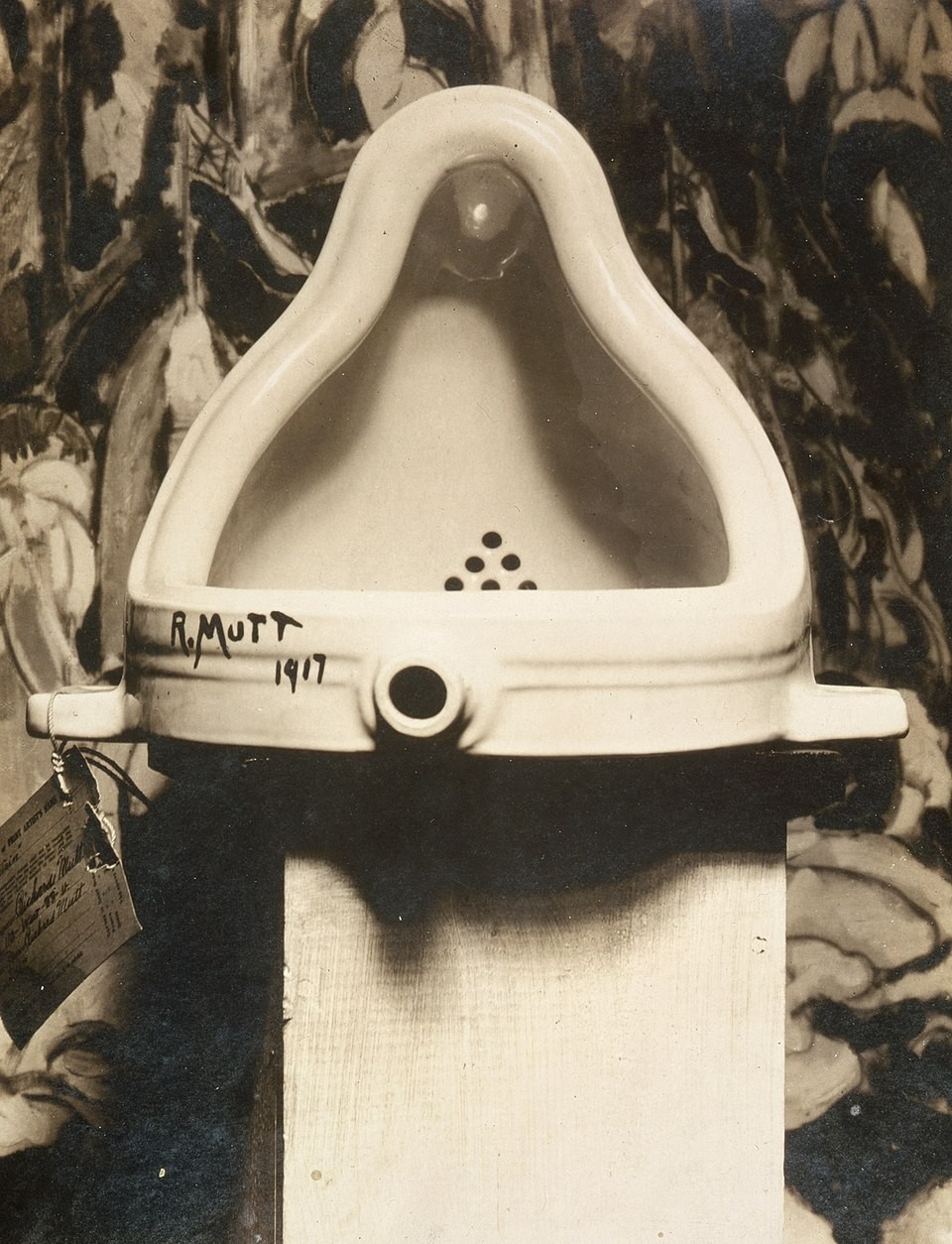
The exhibition had announced that it would display any work submitted with the required fee. Duchamp entered the piece under the pseudonym “R. Mutt.” Despite the open policy, the organizers quietly rejected it. Many in the art community were outraged. Others were offended. Some dismissed it as a joke or an insult.
At that time, the art world had not yet redefined what art could be. Art was still largely associated with beauty, skill, and craftsmanship. A manufactured bathroom fixture did not fit within that definition. The controversy was not merely about taste. It was about the boundaries of art itself.
Was art defined by technical execution? By beauty? By effort? Or could the artist’s intention alone be sufficient?
It took decades for conceptual art to gain broader acceptance. What Duchamp did was not instantly embraced. It was resisted, criticized, and misunderstood. Yet over time, Fountain came to be recognized as one of the most influential works of the twentieth century.
The object did not change. The human act of selection and framing changed everything. The meaning did not reside in the porcelain. It resided in the human decision to declare it art.
The Parallel with AI
AI today feels to many professionals the way the camera once felt to painters.
Notessa can process documents at extraordinary speed. It can identify patterns and inconsistencies with impressive accuracy. It can generate summaries and surface risk factors in seconds. In certain technical tasks, its capabilities surpass those of any individual professional.
But there is a critical distinction.
AI produces output. Licensed professionals produce judgment, responsibility, and accountability. An AI system can extract clauses, but it cannot assume fiduciary duty. It can flag risks, but it cannot stand behind advice in court. It can generate analysis, but it cannot bear professional liability.
Just as Duchamp’s urinal became art only when a human framed and validated it, AI-generated analysis becomes professional work product only when a licensed attorney reviews it, interprets it, applies context, and stands behind it.
Without that human confirmation, it is information. With that confirmation, it becomes advice. And advice carries responsibility.
What Is Actually Changing
AI does not eliminate the need for lawyers. It eliminates the need for mechanical repetition.
Every major technological shift in history has removed tasks, not professions. Calculators did not eliminate accountants. Excel did not eliminate investment bankers. Email did not eliminate executives. Those tools shifted professionals away from routine mechanics and toward higher-level thinking.
AI is doing the same. It reduces friction in document review. It compresses time. It increases visibility across large volumes of data. What becomes more valuable is interpretation, strategic judgment, negotiation, contextual risk assessment, and client counseling. As processing speed increases, expectations increase. As data increases, complexity increases. And as complexity increases, human judgment becomes more essential, not less. No jurisdiction licenses an algorithm. No client retains software to assume fiduciary responsibility. Clients seek accountable judgment.
The risk in this moment is not that AI replaces lawyers. The risk is that professionals who effectively integrate AI will outperform those who do not. The future belongs to augmented professionals who combine machine precision with human discretion.
The camera did not eliminate artists. It required them to redefine their value. AI is asking us to do the same.
Meaning Requires a Human
Technology can generate information at scale. Only humans can assign meaning, apply context, exercise discretion, and assume responsibility. That is not a sentimental statement. It is a structural reality of regulated professions.
At our firm, we are not building Notessa to replace lawyers. We are building it to remove low-value friction so that licensed professionals can operate at a more strategic level.
AI handles volume. Professionals handle meaning. And meaning is where value lives. In that sense, the future is not smaller for lawyers. It is more demanding and more strategic. Those who adapt will not be diminished by AI. They will be amplified by it.
P.S. I did use ChatGPT in drafting this. The words may have been assisted, but the ideas, perspective, and conviction are entirely my own. Technology can accelerate expression, but meaning still comes from the human behind it.
If you are curious how that same principle applies to legal work, we would be glad to show you how Notessa can elevate and accelerate your document review process. Visit notessa.ai or reach out to us to continue the conversation.
Cheers!