
Key Takeaways
Introduction
Artificial intelligence and large language models have moved from novelty to infrastructure. What began as a more conversational form of search is now embedded directly in professional workflows through platforms such as ChatGPT, Claude, Perplexity, and a growing ecosystem of agent-based systems built on similar models. The immediate implication is clear: AI can now perform many tasks that once belonged to junior and mid-level knowledge workers, often faster and at quality levels that rival human output. The role of the professional is shifting from direct production toward orchestration. The individual defines the problem, instructs the system, evaluates the result, and decides what to trust and act on.
AI is therefore a genuine force multiplier. One person can now produce work that previously required a larger team or significantly more time. But the central issue is not productivity. The more consequential question is how expertise will be formed in an AI-driven workplace. Experienced professionals can use AI effectively because they already possess domain knowledge and judgment built through years of practice. The question is whether that same judgment can still be developed when AI increasingly performs the underlying work that once served as the training ground for new professionals.
The Expertise Formation Problem
Effective use of AI still depends on human expertise. A professional must be able to determine whether an AI-generated answer is correct, relevant, complete, and appropriate for the context. That kind of judgment is not acquired abstractly. It is built through repeated cycles of effort, error, feedback, and revision. Traditionally, this has taken the form of apprenticeship. Junior professionals perform first-pass analysis, draft documents, build models, and research issues. They make mistakes that more experienced colleagues then correct. Through repetition, they learn not only what the right answer is, but how to recognize tradeoffs, ambiguity, and hidden risk.
The Structural Imbalance
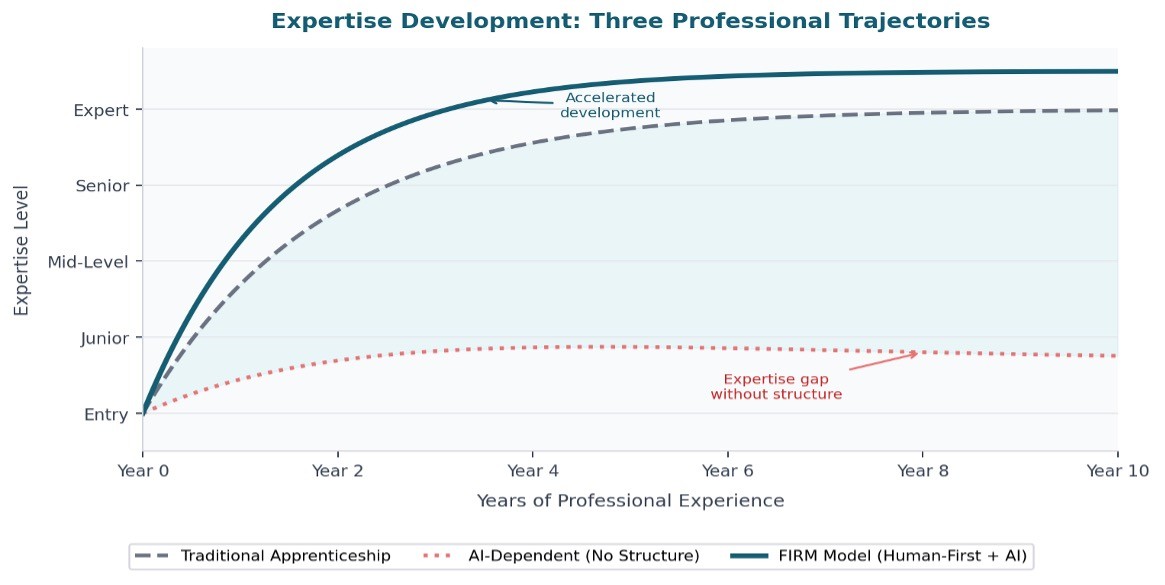
AI removes this developmental pathway. If a model produces the initial draft, the first-pass analysis, or the foundational research, the junior professional may never encounter the sequence of decisions that historically built expertise. Reviewing AI output is useful, but it is not the same as generating the work independently. It reduces exposure to uncertainty, weakens the discipline of forming an original view, and eliminates the opportunity to learn through failure.
Senior professionals become more productive because they already have the judgment needed to direct and evaluate AI, while junior professionals risk becoming dependent on tools before they have developed the capabilities those tools require. AI does not remove the need for expertise. It removes the process by which expertise is created.
A Direct Consequence: Output Inflation
When individuals lack the judgment to determine what matters, AI amplifies the problem. It produces longer, more polished, and more comprehensive output, but without the prioritization and selectivity that come from experience. The result is what might be called output inflation: an increase in volume without a corresponding increase in insight or usefulness.
"Output inflation is not simply a productivity issue. It is a symptom of underdeveloped expertise. Work product includes excessive detail, low-priority information, and reasoning that appears coherent but is not well grounded."
In fields such as finance, law, and real estate, this creates real risk. Clarity and prioritization are essential, and both depend on judgment. Without sufficient expertise, AI does not reduce complexity. It increases it. Output inflation therefore reinforces the central issue: the challenge is not simply how to use AI more efficiently, but how to ensure that the individuals using it have the capability to filter, prioritize, and interpret what it produces.
The FIRM Model: First Input, Refined by Machine
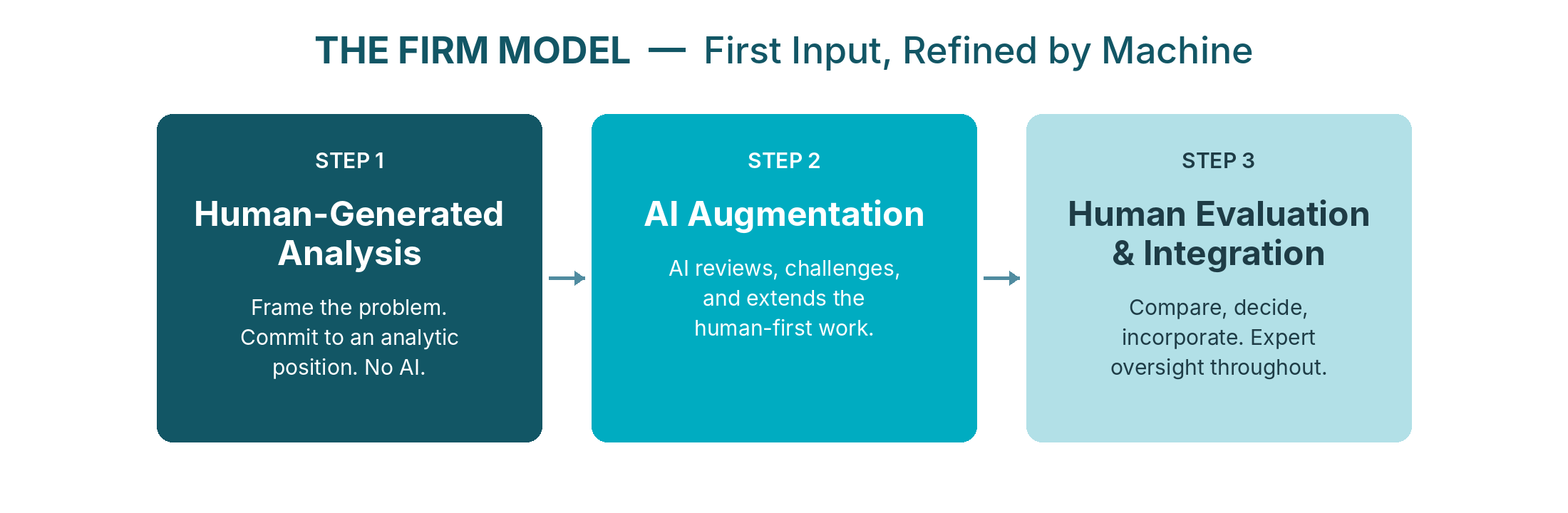
The answer is not to exclude AI. That is neither practical nor desirable. The more effective approach is to structure workflows so that human reasoning comes first and AI is used to refine, challenge, and extend that reasoning. This is the core principle behind what I refer to as the FIRM Model: First Input, Refined by Machine.
The model operates through a structured feedback loop that restores the mechanics of learning while enhancing output quality.
Step 1: Human-Generated Analysis
The individual produces an initial work product independently or with minimal reliance on AI. This requires framing the problem, identifying what matters, and committing to an analytic position. These are the activities that build judgment over time. It is also worth noting that the quality of AI output is directly tied to the quality of this initial input. Well-structured questions, clearly articulated assumptions, and thoughtful initial analysis produce more relevant and useful responses. Weak inputs lead to generic and unfocused output. Requiring individuals to produce a structured first pass therefore improves both the learning process and the effectiveness of AI at the same time.
Step 2: AI Augmentation
The initial work product is then provided to AI. At this stage, AI is used to identify missing considerations, suggest counterarguments, highlight structural weaknesses, and improve clarity. In this role, AI functions as a decision-augmentation tool rather than a substitute for original thinking.
Step 3: Human Evaluation and Integration
The individual compares AI feedback against the original analysis and determines what to incorporate. This is where learning occurs. It exposes blind spots, reinforces correct reasoning, and builds pattern recognition. A senior professional can identify issues that neither the junior nor the AI may recognize, particularly in areas involving judgment, market norms, and nuanced risk.
A Critical Constraint
The FIRM Model depends on the availability of experienced professionals to provide expert review. If AI adoption gradually reduces the size of junior cohorts over time, the pipeline of future senior mentors may thin as well. Organizations that implement a human-first framework today are also protecting the conditions that make expert oversight possible in the future. The two objectives are not separable.
The AI Manager: What the New Role Actually Requires
The shift from direct producer to AI manager is not simply a change in workflow. It is a change in what competence means. The AI manager does not need to be the fastest at generating output. The AI manager needs to be the most capable at directing, evaluating, and improving it.
This requires a specific and demanding set of skills:
"The irony is direct: the role that AI is creating requires exactly the kind of expertise that AI adoption, if left unmanaged, will prevent people from developing."
Organizational Response
AI adoption is not simply a productivity initiative. It is a capability development challenge, and without a deliberate response, organizations will face a compounding problem: a widening gap between experienced professionals and junior staff, combined with increasing reliance on AI outputs that fewer people have the judgment to validate.
Structural Response
The structural response is straightforward. Firms should require a human-generated first pass for developmental work, particularly for junior professionals. AI should be positioned as a refinement and challenge tool rather than the default originator of work. Senior professionals should remain actively involved in reviewing both output and reasoning, not as editors, but as developers of the judgment that the next generation of AI managers will need.
Behavioral Response
The most convenient use of AI requires the least amount of effort, and without structure, individuals will default to using AI to generate work and accept outputs at face value. Organizations must address this through incentive design:
Conclusion
AI removes the process by which expertise is created, and it does so quietly, by making it easier to skip the steps that were never obviously valuable until they were gone. The FIRM Model is a practical response: by requiring human-generated analysis first, layering AI refinement on top of it, and maintaining expert oversight throughout, organizations can restore the developmental mechanics that AI adoption otherwise displaces.
The Strategic Stakes
The professionals who will manage AI systems most effectively are those who understand what AI gets wrong, what it cannot prioritize, and where its confidence is unearned. That understanding comes from experience. It cannot be prompted, and it cannot be generated. Short-term productivity gains are real, but they are not free. The cost is paid in the judgment that never gets built.
The challenge is not whether AI will be used. The challenge is whether it will be used in a way that produces the next generation of professionals capable of using it well.