
Commercial real estate professionals do not need another AI chat window. They need a system that can work across the legal documents, financial information, property data, and recurring obligations behind a deal while preserving the source trail and professional accountability.
That distinction matters. General-purpose AI can summarize a document or answer a question. Broad legal AI platforms can support research, drafting, and document review across many areas of law. Commercial real estate work presents a different problem. A decision may depend on the interaction among a loan agreement, guaranty, leases, rent roll, historical operating statements, appraisal, and prior transactions. The information is spread across formats, teams, and stages of the investment lifecycle. An answer that ignores those relationships may be incomplete even when it accurately describes one document.
We developed Notessa to address that problem. The platform is designed around the asset and the deal, with the goal of making legal, financial, and operating information usable together. It does not replace professional judgment. It reduces the time spent locating, organizing, and reconciling information so that professionals can devote more attention to the decisions for which they remain responsible.
My perspective comes from working as an attorney on complex commercial matters, supporting capital markets teams as in-house counsel, and managing billions of dollars in lending facilities at Goldman Sachs, including during the Great Financial Crisis. In each role, I saw how fragmented information and ordinary human error could create significant risk. I also saw that useful technology must fit the way experienced professionals actually work. Those lessons shaped four principles behind Notessa.
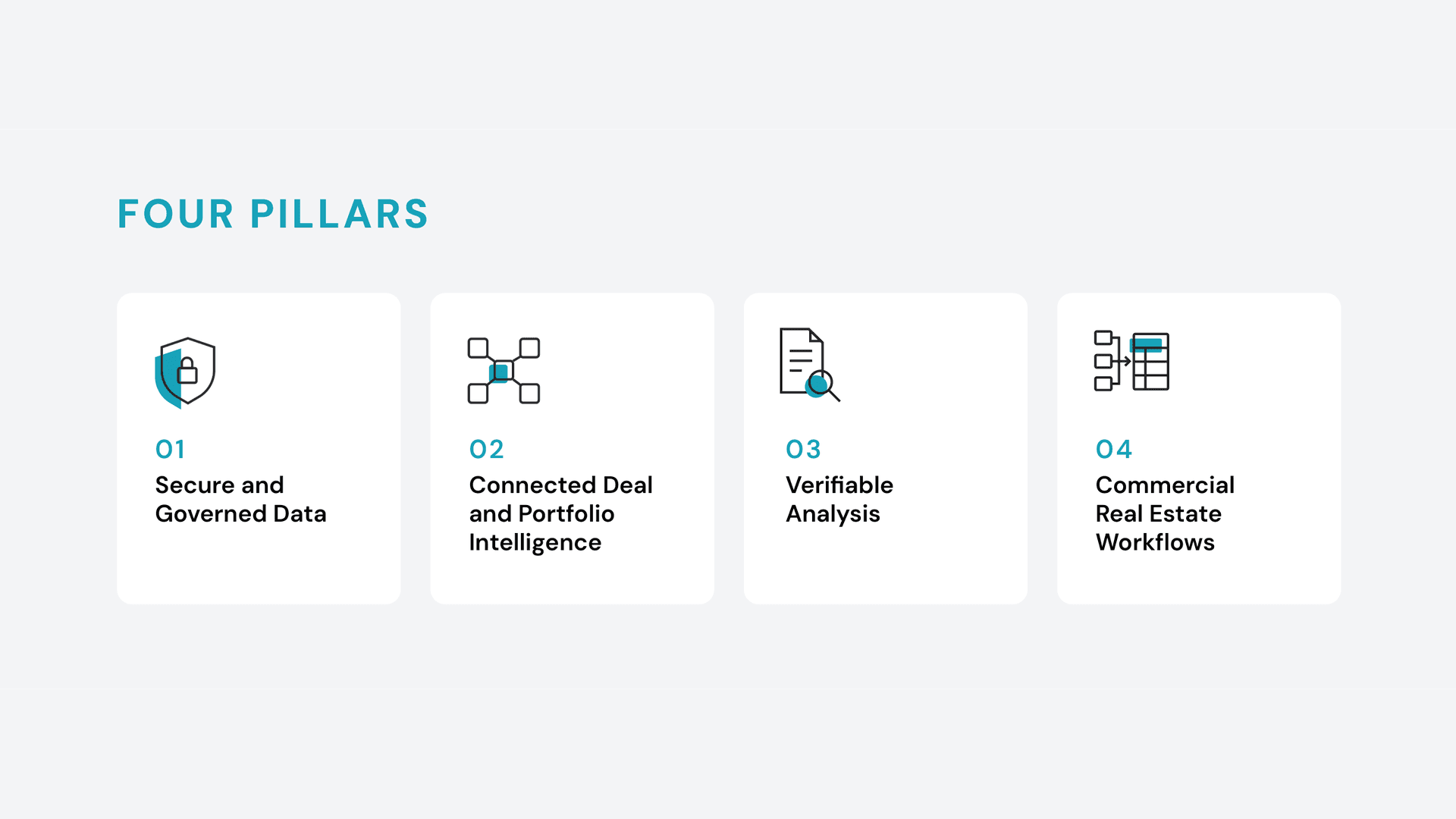
01 Secure and Governed Data
Commercial real estate files contain confidential business information, privileged communications, tenant data, financial records, and material deal terms. Security is therefore a threshold requirement, not a feature that can be added later.
Notessa stores each client's data in a logically isolated, tenant-scoped AWS environment. We use AI models through API arrangements that prohibit model providers from using client data to train their models. Where a client has more stringent requirements, models can be hosted through Amazon Bedrock or deployed locally, subject to the capabilities and limitations of the selected model.
Security also requires governance after the infrastructure is in place. Notessa maintains policies and procedures for protecting client data and audits those controls against SOC 2 requirements. The objective is to give organizations control over the information available to the system while allowing authorized team members to use the same governed body of material.
Security alone does not distinguish a serious enterprise platform. It is the foundation that makes the remaining capabilities usable in high-stakes work.
02 Connected Deal and Portfolio Intelligence
The harder problem is context. A document rarely stands alone in commercial real estate. A covenant in a loan agreement may depend on a defined term elsewhere in the agreement, financial information maintained by the asset-management team, and a deadline that must be monitored after closing. A lease affects legal rights, underwriting assumptions, cash flow, and the stacking plan. A guaranty matters because of its relationship to the borrower, the loan, and the property.
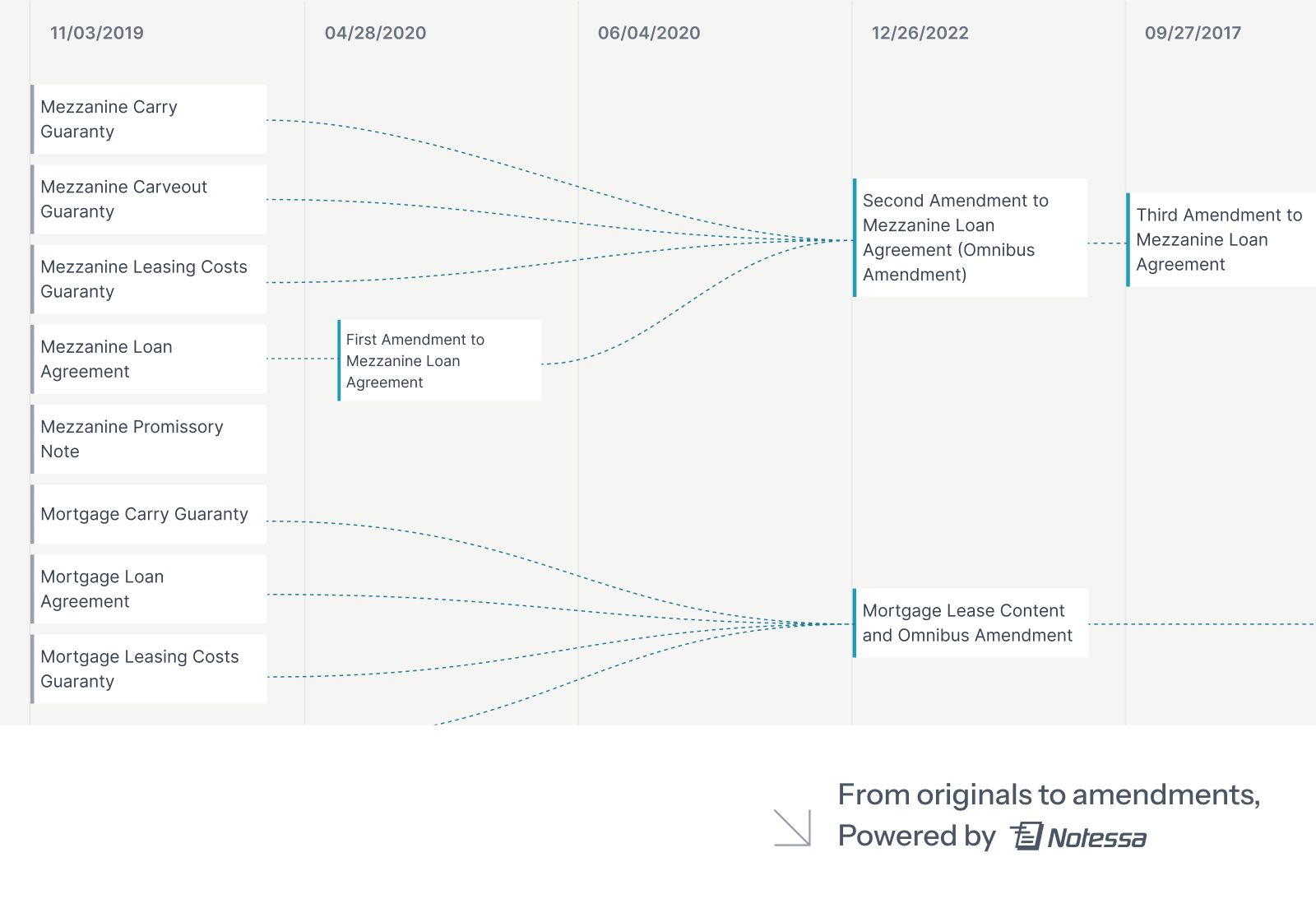
Notessa allows teams to upload or synchronize PDF, Word, Excel, and image files once and use them across authorized workflows. The purpose is not merely to create another file repository. It is to make the materials behind a deal available together so that a question can be answered in the context of the asset, the transaction, and the client's other relevant information.
This becomes more valuable as the body of information grows. A user can ask which indemnification provisions the organization has accepted in prior transactions. An underwriting team can use historical financials together with comparable rent information from other properties. An asset-management team can create a calendar of covenants and follow-up dates across loan documents. The same information can support legal review, underwriting, closing, and ongoing portfolio management without requiring each team to rebuild the context from scratch.
This is the principal difference between Notessa and a general AI assistant. The assistant begins with the prompt and the documents supplied for that interaction. Notessa is designed to preserve and reuse the commercial real estate context surrounding the work.
03 Verifiable Analysis
AI output should never be treated as self-proving. A plausible answer can still omit a qualification, misread a defined term, or rely on the wrong provision. In commercial real estate, those errors can affect legal rights, financial projections, and risk decisions.
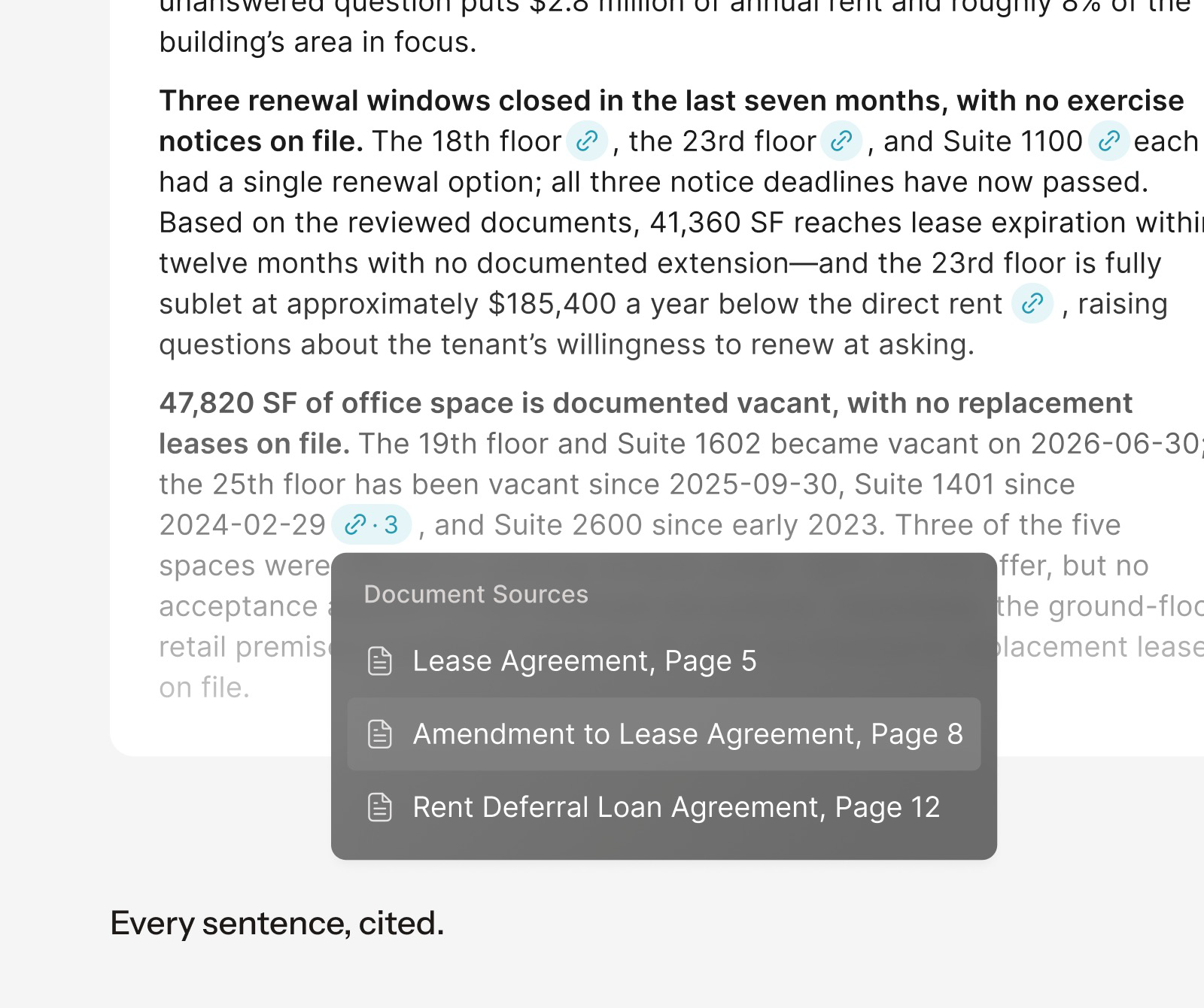
Notessa connects answers to the source material used to produce them. A user can open the cited file and move directly to the relevant provision. This shortens the path from an AI-generated answer to professional verification. The user still exercises judgment, but less time is spent locating the evidence behind the answer.
The same principle informs document review. Defined terms are highlighted and can be viewed without leaving the provision under review. Section references can be opened directly, including references that point to another document, such as a guaranty referenced in a loan agreement. These functions matter because the meaning of a provision often depends on language located elsewhere in the transaction documents.
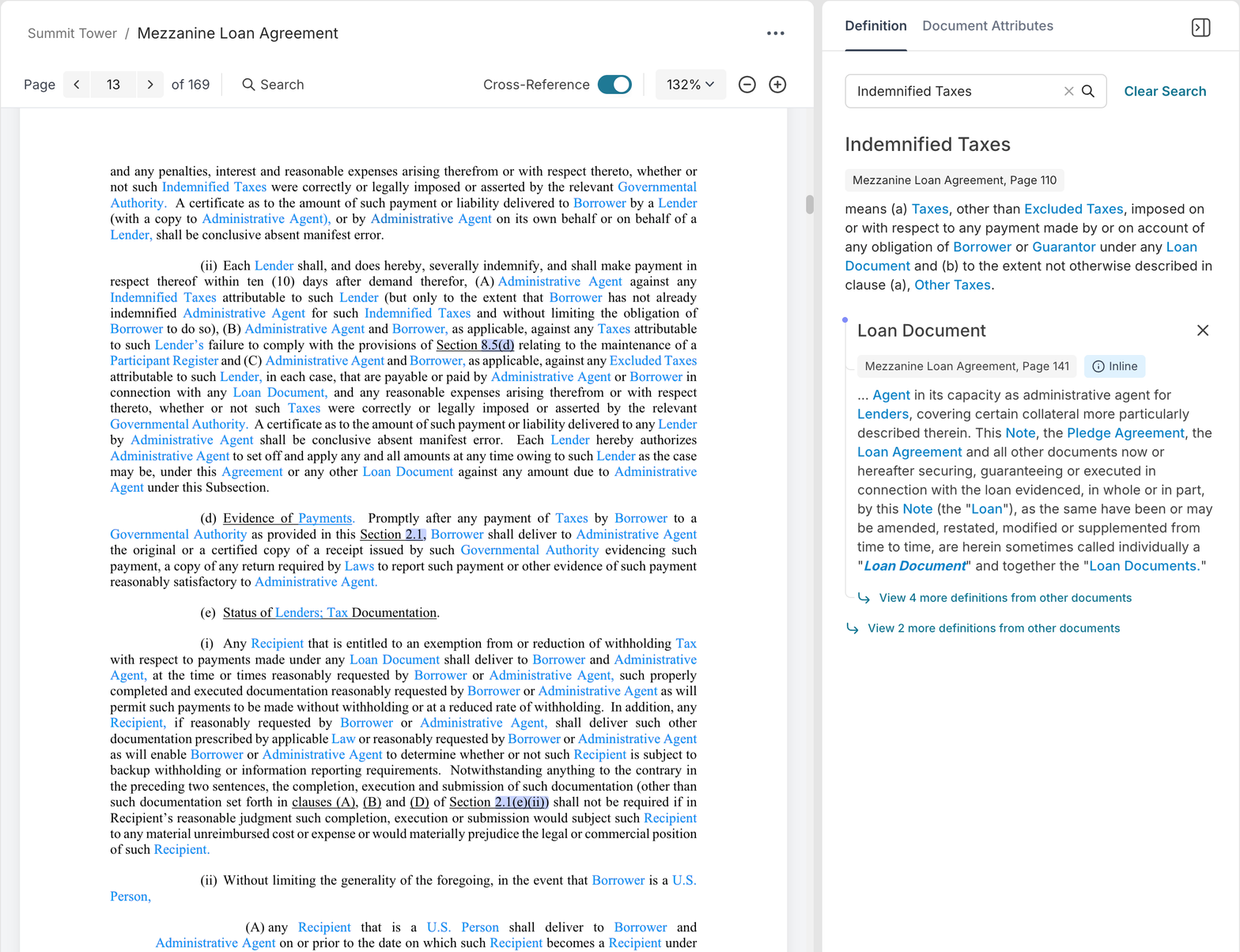
Verification is not a promise that AI will always be right. It is a workflow that makes the system's work easier to examine, challenge, and correct.
04 Commercial Real Estate Workflows
The final principle is domain-specific execution. A generic prompt can ask an AI model to summarize a lease. It does not necessarily tell the model which provisions a commercial real estate professional expects to see, how the information should be organized, or what must be consistent across a portfolio.
Notessa incorporates recurring commercial real estate tasks and expected work-product formats into the platform. A user can request lease abstracts and a stacking plan without reconstructing a lengthy set of instructions each time. The system is designed to apply the same analytical structure across documents so that outputs are easier to compare, review, and reuse.
This principle extends beyond lease review. The value lies in translating professional methods into repeatable workflows for activities such as document analysis, underwriting support, comparison of historical deal terms, and covenant monitoring. The user supplies the objective and remains responsible for the result. Notessa supplies the structure, relevant context, and connection to the underlying evidence.
Calling this capability prompting understates it. A prompt is an instruction to a model. A workflow identifies the required inputs, applies a defined method, produces a usable form of work product, and preserves a path back to the source information.
Technology Can Change Without Losing the Work
AI models will continue to improve, and today's leading model may not remain the best choice for every task. Notessa is therefore not designed around dependence on a single model. Its more durable components are the client's governed information, the connections among that information, the commercial real estate workflows applied to it, and the record supporting each output.
This approach allows the underlying technology to evolve without forcing the organization to recreate its data structure, work processes, or accumulated knowledge each time a better model becomes available. Model capability matters, but it becomes useful only when it operates within a system that reflects the work being performed.
Professional Judgment Remains Central
Notessa is intended to help professionals reach better-supported decisions with less avoidable effort. It does not make investment decisions, give final legal approval, or remove the need to review the governing documents. Responsibility for the work remains with the people who understand the transaction, the client, and the consequences of the decision.
What Notessa can do is give those professionals a more useful starting point. It can bring the relevant materials together, apply a repeatable commercial real estate workflow, and show the evidence behind the resulting analysis. That combination distinguishes Notessa from a generic AI interface and from broader legal platforms built to serve many practices. Notessa is designed for the connected legal, financial, and operating work of commercial real estate.